

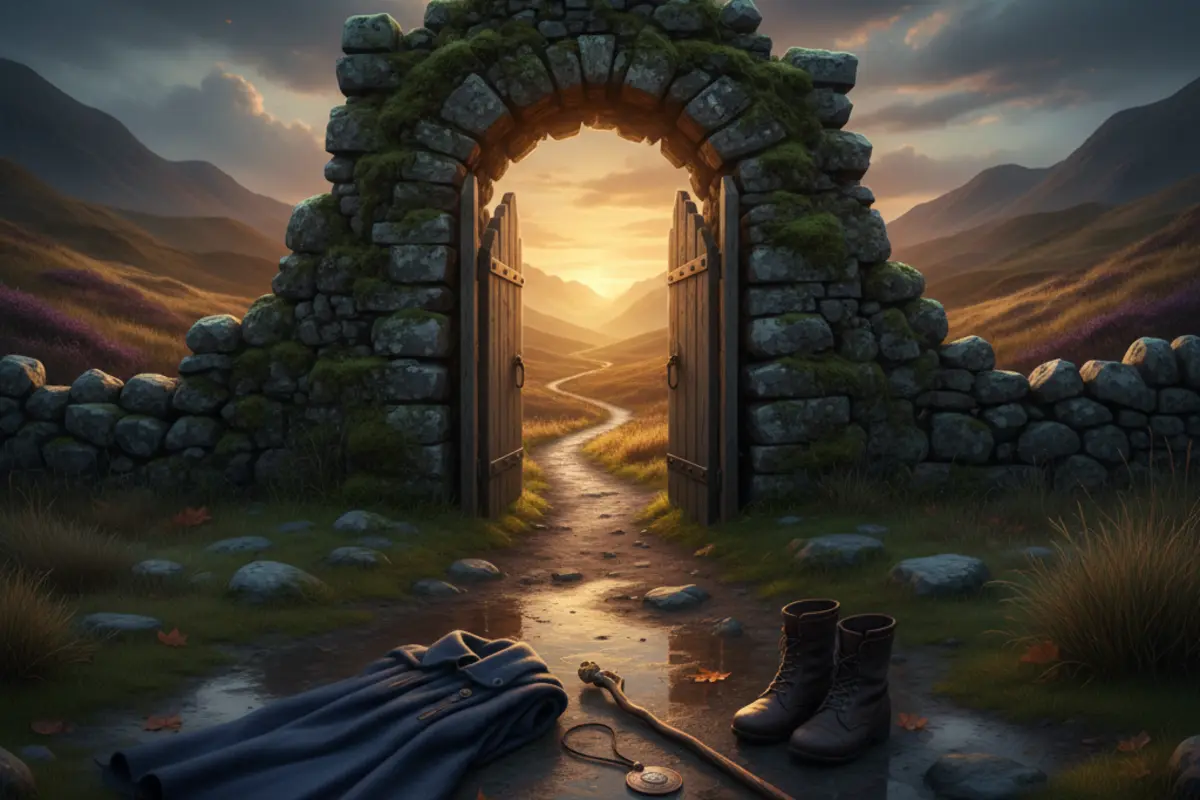
There is an old story — older than writing, older perhaps than cities — about a traveler who came to a gate.
The gate stood between two worlds. Behind: everything the traveler had built. A life assembled carefully, stone by stone. Solid. Familiar. Good enough.
Ahead: a country with no map.
At the gate sat a figure. Not a monster. Not a warrior. Just someone who had been there a long time and who asked a single question:
What are you willing to leave at the threshold?
The Greeks called this moment katabasis — the descent. Not a fall, but a choosing-down. Persephone at the mouth of the Underworld. Orpheus at the river's edge. Odysseus standing at the entrance to the land of the dead, knowing he would have to listen before he could return.
None of them were forced through. That's the part the stories get right: the threshold guardian doesn't block the path. The guardian reveals the price of the ticket.
And the price is always the same — you must set down the version of yourself that cannot survive the crossing.
The Norse had Heimdallr, who stood at Bifröst — the rainbow bridge between the world of the living and the realm of the gods. He could hear grass grow. He could see for a hundred leagues. And yet his role was not to see everything — it was to ask:
Do you belong on the other side?
Not "are you worthy." Not "are you ready." Do you belong there?
Because belonging isn't earned by preparation. It's recognized by willingness.
There are places — the Celts called them thin places — where the distance between this world and another narrows to almost nothing. A hilltop at dusk. A shore where the tide turns. The space between one breath and the next.
The thin place isn't the destination. It's the moment before you realize you've already decided.
So the traveler stood at the gate. And the figure asked the question. And for a long time there was only silence — the kind that isn't empty but full, the way a held breath is full.
And then the traveler said:
I'm afraid I won't recognize myself on the other side.
And the guardian said:
That's the right answer.
And the gate was already open.

